Trying to pick the “right” part of Wilton can feel harder than choosing the house itself. You may want a shorter train trip, more yard space, lower-maintenance living, or a home with historic character, and in Wilton those priorities often point to different parts of town. The good news is that Wilton has a clear housing pattern once you know what to look for. Let’s break it down so you can match your lifestyle to the right neighborhood pocket and home style.
How Wilton’s Housing Pattern Works
Wilton is largely a detached-home, owner-occupied community. Census QuickFacts show an owner-occupied housing rate of 88.6%, with a median owner-occupied home value of $928,800 and median monthly owner costs with a mortgage above $4,000.
The town’s Plan of Conservation and Development, often called the POCD, says about 84% of Wilton’s housing units are single-family homes. That helps explain why larger-lot properties are the default here, while condos, townhomes, and other more compact options are concentrated in a smaller number of areas.
Instead of many sharply defined neighborhoods, Wilton is organized around a few key places. The town identifies Wilton Center, Cannondale, Georgetown, and the Danbury Road corridor as important activity areas, each with a different feel and housing mix.
Start With Your Priorities
Before you focus on style, start with how you want to live day to day. In Wilton, your commute, lot-size goals, maintenance preferences, and interest in historic character can quickly narrow the search.
A simple way to think about it is this:
- If rail access matters most, start near Wilton Center and Cannondale.
- If privacy and a larger yard matter most, focus on lower-density single-family areas.
- If you want lower-maintenance living, look at the districts and redevelopment areas where more compact housing is allowed.
- If you love older homes, confirm whether the property is in a historic district and whether exterior changes may be reviewed.
That order matters because it keeps you from chasing homes that look appealing online but do not fit your daily routine. In Wilton, the best fit is usually about alignment, not a universally “best” neighborhood.
Wilton Center for Convenience
Wilton Center is the town’s focal point for economic and cultural activity. The POCD also notes that it includes the Wilton Train Station and has already benefited from streetscape improvements.
If you want a more convenience-oriented lifestyle, this is often the first place to consider. Buyers who value easier access to services, a more walkable setting, and a shorter hop to the train often start here.
Wilton Center is also one of the places the town sees as appropriate for mixed-use and transit-oriented development. That makes it especially relevant if you are hoping to find housing options beyond the classic large-lot single-family pattern.
Best fit for Wilton Center
Wilton Center may appeal to you if you want:
- Proximity to the train
- Easier access to town amenities and services
- A more compact setting than other parts of Wilton
- Potential access to more diverse housing types
Cannondale for Village Character
Cannondale offers a smaller historic village setting with rail access. The town describes it as a distinct historic village, and the Cannondale Train Station is part of the Metro-North Danbury Branch.
For many buyers, Cannondale hits a sweet spot. You can get village atmosphere and older-home character without being in the busiest part of town.
The town’s planning framework also emphasizes protecting Cannondale’s unique design and historical character. If that kind of setting matters to you, Cannondale is an area worth studying closely.
Best fit for Cannondale
Cannondale may be a strong match if you want:
- A smaller village feel
- Access to a train station
- Older homes and established character
- A setting that feels connected but not overly busy
South Wilton and Danbury Road for Access
If convenience, corridor access, and a somewhat broader mix of housing forms are high on your list, South Wilton deserves attention. The POCD says Danbury Road in South Wilton contains the highest-density development in town.
The town also identifies Danbury Road south of Cannon Road as a priority development area. Future growth there is expected to come mainly through redevelopment of older or underperforming land uses.
Another practical point is infrastructure. The POCD notes that sanitary sewer service is available on Danbury Road south of Olmstead Hill Road and in Wilton Center, which helps explain why denser projects are more likely to cluster in these areas.
Best fit for South Wilton
South Wilton may work well for you if you want:
- Quick access along the Danbury Road corridor
- Proximity to services
- A better chance of finding newer or more compact housing forms
- A location tied to existing infrastructure that supports denser development
North of Cannondale for Space
North of Cannondale, Wilton shifts to a more rural pattern. The POCD says Danbury Road north of Cannon Road is primarily rural and that the town wants to preserve established lower-density residential neighborhoods.
For buyers who picture privacy, larger setbacks, and a more wooded setting, this part of town often lines up with that goal. It is the side of Wilton where the lower-density identity is most visible.
If your ideal home includes more land and a stronger sense of separation from the main corridor, this is likely where you will spend more of your search time. It is often a better fit for the buyer who wants space first and convenience second.
Best fit for North Wilton areas
You may prefer this part of town if your priorities are:
- More privacy
- Larger lots
- A lower-density setting
- A more rural feel
Georgetown as a Special Case
Georgetown has a distinct identity, but it is important to remember that it spans Wilton, Redding, and Weston. Wilton’s POCD describes it as a historic village and notes plans to strengthen it as a mixed-use node centered around the Gilbert & Bennett mill complex.
If you are drawn to an old-village setting, Georgetown can be appealing. Just make sure you confirm exactly which municipality a property is in before assuming anything about town services or other local details.
That extra step matters here more than in other parts of Wilton because the village crosses town lines. A charming address can come with a different municipal context than you first expect.
What Home Styles to Expect in Wilton
Wilton’s zoning makes the overall housing picture fairly clear. The town’s R-1A and R-2A districts are single-family residence zones with minimum lot sizes of 1 acre and 2 acres, respectively.
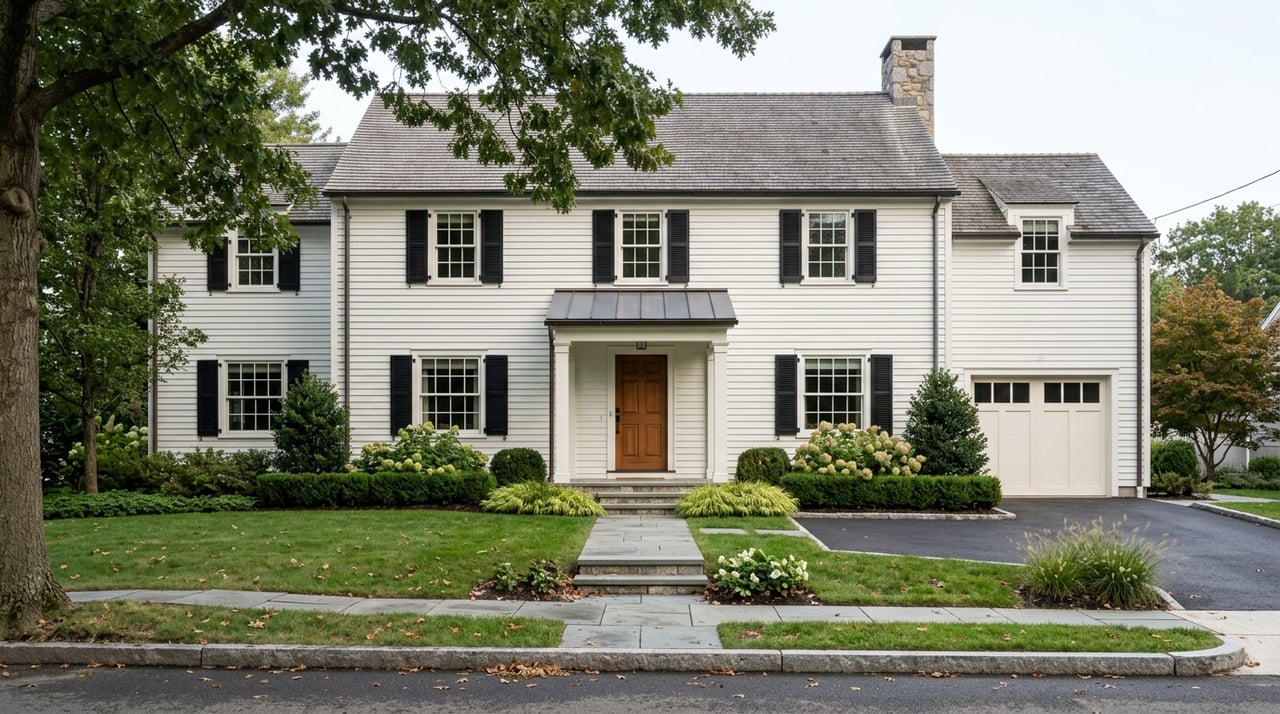
In plain terms, that means larger-lot single-family homes remain the dominant housing type. If you are shopping for a classic colonial, an antique home, or an estate-style property, much of your search will likely center on these single-family areas and historic pockets.
At the same time, Wilton also has districts that allow more compact housing forms. These include center/apartment, townhouse, and other special districts such as CRA-10 and THRD, along with other mixed-housing categories.
Single-family homes
Single-family homes are the core of Wilton’s housing stock. They are generally the best match if you want more land, more separation between homes, and the traditional suburban setup many buyers associate with the town.
This category also covers a wide style range. Depending on the location, you may see classic colonials, antique properties, and larger estate-style homes.
Condos and townhomes
If your priority is lower-maintenance living, do not assume that option is common everywhere in town. More compact housing types are concentrated in a relatively small number of districts and redevelopment areas.
That is why buyers looking for a condo or townhome often focus on Wilton Center, Cannondale-adjacent areas, and other special districts rather than searching broadly across all of Wilton. A targeted search usually saves time.
Historic homes
Wilton has substantial historic resources. The POCD says the town includes three National Historic Districts, five Local Historic Districts, and about 470 significant structures documented in historic resource inventories.
If you love antique homes or historic character, ask early whether the property is in a Local Historic District. The town notes that exterior changes visible from a public way may be subject to review in those districts.
Commute and Lifestyle Filters
For many buyers, commute is the first real tie-breaker. Wilton has two Metro-North stations on the Danbury Branch, Wilton and Cannondale, and the current branch map shows that select rush-hour trains run to and from Grand Central, while other times may require a transfer at South Norwalk.
That makes station access an important part of your neighborhood choice. If train use is central to your routine, starting near station-oriented areas can make your home search more efficient.
Lifestyle is the next filter. Wilton’s parks and trails add another layer to the decision, especially if you want easy access to outdoor space.
The town says Merwin Meadows includes a swimming pond, beach, pavilion and grills, bathhouse, playground, and athletic field. Schenck’s Island in Wilton Center offers a large lawn, scenic meadow, walking trails, and fishing in the Norwalk River.
Wilton also includes town, state, and federal trails, open spaces managed by the Wilton Land Conservation Trust, walkable easements, and the Norwalk River Valley Trail. If outdoor access is part of your daily routine, it is worth comparing neighborhoods through that lens too.
A Simple Way to Choose
If you feel torn between several parts of town, use a practical four-step filter. Start with commute, then lot size, then home style, then nearby amenities.
That framework works well in Wilton because each factor tends to point to a different part of town. Rail-oriented buyers often start in Wilton Center or Cannondale, while buyers focused on privacy and land often lean farther from the corridor.
The goal is not to find the one best neighborhood. It is to find the part of Wilton that best supports how you actually want to live.
If you want help narrowing the search, comparing Wilton pockets, or deciding whether a single-family home, condo, townhome, or historic property fits your goals, Marlee Book can help you build a smart, local plan.
FAQs
What type of housing is most common in Wilton?
- Wilton is primarily a single-family home market. The town’s POCD says about 84% of housing units are single-family, and zoning in many areas reinforces that larger-lot pattern.
Which Wilton area is best for train access?
- Buyers who prioritize rail access usually begin with Wilton Center, Cannondale, and nearby station-oriented pockets because Wilton’s two Metro-North stations are located in those areas.
Where should you look in Wilton for more privacy and land?
- Lower-density areas north of Cannondale and outside the main corridor are often the best fit if you want more privacy, larger setbacks, and a more rural setting.
Where can you find condos or townhomes in Wilton?
- More compact housing options are generally found in Wilton Center, Cannondale-adjacent areas, and other special zoning districts rather than evenly spread across town.
What should you know about buying a historic home in Wilton?
- If a home is in a Local Historic District, exterior changes visible from a public way may be subject to review, so it is smart to confirm that status early in your search.
How do you narrow down neighborhoods in Wilton?
- A practical approach is to rank your priorities in this order: commute, lot size, home style, and nearby amenities. In Wilton, that usually gives you a much clearer starting point.